
Sleep with Neck Pain
HOW TO SLEEP WITH NECK PAIN
Neck pain isn’t just “part of getting older.” In my view, most neck pain that shows up in the morning is engineered—quite precisely—by how you sleep. The way your head hangs off a too-tall pillow, the way your shoulder is jammed under a sagging mattress, the way you twist your neck to reach a second pillow because your first one collapsed at 2 a.m.—that’s not random. That’s biomechanics. And if you ignore it, no amount of stretching or massage is going to save you from waking up stiff and irritated.
I learned this the hard way in my early 30s. I’d wake up every morning feeling like I’d slept in the overhead bin of an airplane—tight traps, burning pain at the base of my skull, and a headache that showed up like clockwork by 11 a.m. I blamed my desk job, my phone, my workouts—everything except the one thing I was doing for seven hours straight every night: sleeping in a terrible position on a worse pillow and a “good enough” mattress. Once I changed those three variables with intention, my “chronic” neck pain faded in weeks.
If you’re wondering how sleep is causing neck pain, you’re asking the right question. The average person spends over 25 years of their life asleep. That’s 25 years of either gently supporting your cervical spine…or slowly grinding it into misery. Let’s break down, in very practical terms, how to sleep with neck pain now—and how to sleep in a way that helps prevent it in the future.
Understanding Sleep and Neck Pain
We need to firstly learn how our sleep habits and environment might be causing neck pain, and then discover solutions to alleviate it.
- Side & back sleeping positions with proper support reduce neck pain, while poor posture during sleep can worsen it.
- Supportive pillows help to maintain neck alignment and relieve pain.
- Mattress choice does matter, as you need adequate support to prevent neck discomfort during sleep.
The Best Sleeping Positions for Neck Pain
Not all sleeping positions are created equal. Some make it almost impossible for your neck to relax. Ohers give your spine a neutral, supported posture that lets irritated joints and muscles calm down overnight.
We would rank sleeping positions in this order, from best to worst:
- Sleeping on your back (with the right pillow)
2. Sleeping on your side (with careful alignment)
3. Sleeping your stomach (the worst, and almost always the culprit for neck pain)
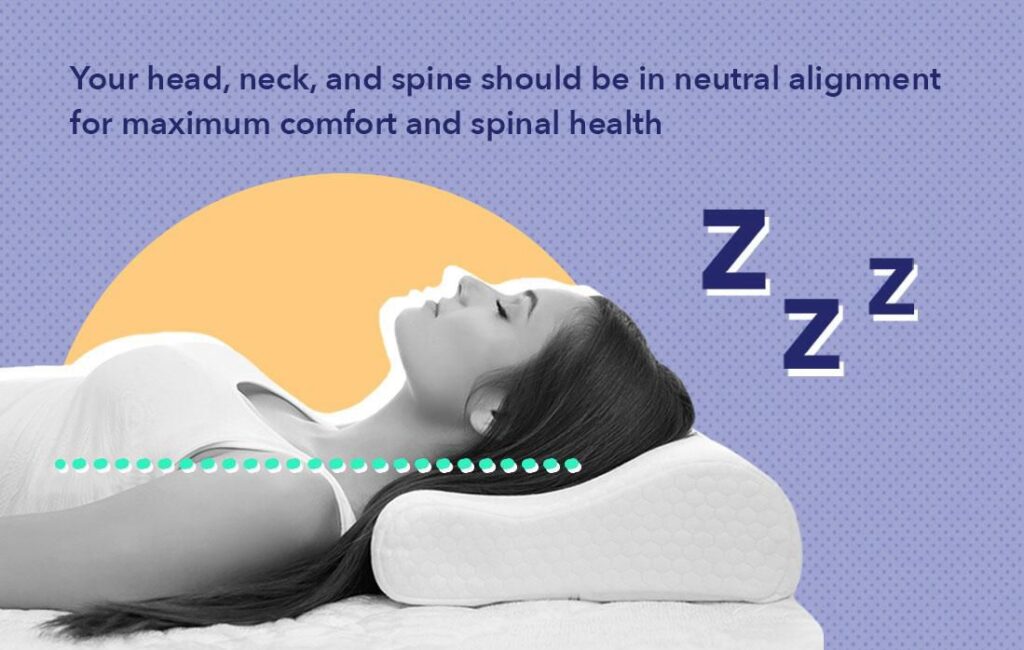
Why Neutral Alignment Matters More Than “Comfort”
“Comfort” can be deceiving. For instance, some of us may love sleeping half on the stomach, half on the side, one arm overhead, face twisted into the pillow. So cozy! But just try holding this position even for just 5 minutes while awake and see how your neck feels then. Now, imagine doing this night after night, for hours.
What is Neutral Alignment?
- Your nose is in line with your sternum; there is no twisting.
- Your ears are level with each other; there is no side-bend.
- Your chin is not jutting up (neck in extension) or jammed down (neck in flexion).
Imaging and biomechanical studies have shown that even small deviations from Neutral Alignment can increase compressive and shear forces on your cervical discs and facet joints. One review in the Journal of Manipulative and Physiological Therapeutics found that sustained neck flexion / extension during sleep can aggravate both discogenic pain and facet joint irritation, especially in people already dealing with neck issues. You can read more on cervical spine mechanics in sources like Spine-health.
When your sleep position chronically pushes your neck out of neutral, you’re basically imposing low-grade micro-trauma on your body for a third of your life.
Sleeping on our back: The Most Forgiving Position
If your neck is angry, back sleeping is usually the most forgiving option—provided you set it up correctly. The goal is to support the natural curve (lordosis) of your neck without pushing your head forward.
For back sleeping:
- Use a medium-loft pillow that gently fills the space under your neck.
- Avoid stacking pillows up. The added height will force your head into flexion – not what you want.
- If your lower back is tight, place a small pillow under your knees. This helps your entire spine to relax, including your neck.
- Your gaze should be straight up – not angled down towards your feet, nor back towards the wall or bedhead.
Sleeping on your side: The Practical Compromise
Many people simply can’t sleep on their backs all night, so side sleeping can be an excellent alternative provided your pillow height and mattress firmness work well together.
For side sleeping:
- Use a pillow that keeps your nose in line with your sternum. No tilting down into the mattress, nor up towards the ceiling.
- Your shoulder must sink into the mattress enough so that your neck isn’t forced sideways.
- A pillow between your knees can help keep your entire spine aligned.
A 2019 study in Nature and Science of Sleep noted that side sleeping with adequate head and neck support was associated with reduced morning neck stiffness. To extrapolate, keep in mind that broad shoulders will require more pillow loft, whereas if you have narrower shoulders, too much pillow loft will only create a new problem.
There was another catch to this 2019 study – if the mattress is too firm, side sleepers still reported neck and shoulder pain.
Sleeping on your stomach: Quite a Problem
Stomach sleeping is the usual suspect when it comes to neck pain, for the simple reason that in order to breathe, you have to rotate your head sharply to one side, often for hours. This rotation compresses facet joints and strains muscles on one side, while overstretching those on the other side.
If you absolutely cannot abandon stomach sleeping:
- Use the thinnest pillow you can tolerate; or no pillow at all.
- Try a hybrid “3/4 side, 1/4 stomach” position with a body pillow, so that you’re less twisted.
- Keep one leg bent and on a pillow, to reduce how far your torso and neck rotate.
In any case, the bottom line is that if you are dealing with persistent neck pain, you should not sleep on our stomach. Retrain yourself gradually
Reference
Lee, W.-H., & Ko, M.-S. (2017). Effect of sleep posture on neck muscle activity. Journal of Physical Therapy Science, 29(6), 1021–1024. https://doi.org/10.1589/jpts.29.1021
Soal, L. J., Bester, C. M., Shaw, B. S., & Yelverton, C. (2019). Changes in chronic neck pain following the introduction of a visco-elastic polyurethane foam pillow. Health SA, 24, 1099. https://doi.org/10.4102/hsag.v24i0.1099

WOO KEN JOE
B.Sc. (Hons) in Physiotherapy, Anglia Ruskin University
Join us on my journey to a healthier lifestyle